

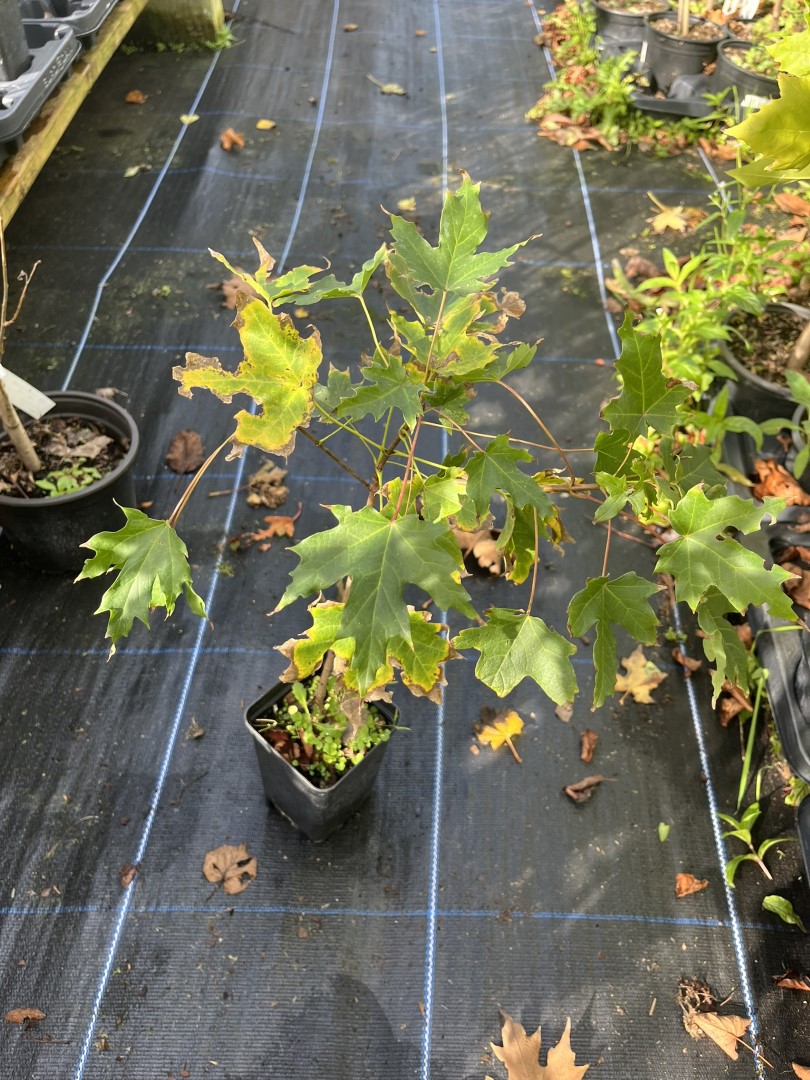


Sugar Maple Tree 20/40cm (P9T)
Acer saccharum - Sugar Maple Tree
£17.19
Sugar Maple Tree – Acer saccharum is a stately deciduous shade tree with five-lobed green leaves that turn yellow, orange and scarlet in autumn. Supplied at 20/40cm in a P9T pot, it is a young, easily established plant for larger gardens, parkland or avenue planting. Best in deep, fertile, moisture-retentive soil in a sheltered, sunny position.
In stock - Usually dispatched within a few days.
Sugar Maple Tree – Acer saccharum is one of the great deciduous shade trees of eastern North America, grown here for its broad, rounded crown, clean grey bark and reliably brilliant autumn colour. This young tree is supplied at 20/40cm in a P9T pot, a practical starting size for gardeners who want to establish a long-lived specimen and watch it develop season by season.
The foliage is the main attraction for much of the year. Each leaf has five rounded lobes with smooth, shallow sinuses, measuring roughly 8 to 14cm across, mid to dark green through spring and summer with a paler, slightly grey-green underside. As temperatures drop in autumn the canopy turns through buttery yellow and warm orange to deep scarlet, often with several shades present on the same branch. Small greenish-yellow flowers hang in clusters in spring before or with the emerging leaves, followed by paired winged seeds known as samaras.
This is the species tapped for maple syrup in Canada and the northern United States, and while sap yields in the comparatively mild British climate are modest, the connection adds interest for anyone planting a tree with a story. Given time and space, the sugar maple forms a substantial, upright-oval tree with a dense canopy that casts generous shade, making it best suited to larger gardens, paddocks, parkland planting or avenues rather than small courtyards.
Sugar maple prefers deep, fertile, moisture-retentive but free-draining soil and dislikes compaction, waterlogging and prolonged drought at the roots. It is also sensitive to road salt and heavy urban pollution, so a sheltered garden setting will always give better results than an exposed roadside position. Autumn colour tends to be strongest where the tree receives full sun for at least part of the day and where nights turn cool and crisp.
Care Guide
Plant between autumn and early spring while the tree is dormant, choosing an open site in full sun or light dappled shade with shelter from strong, drying winds. Dig a planting hole two to three times the width of the root ball but no deeper, loosen the sides, and set the tree so the root flare sits level with the surrounding soil. Firm gently and water in thoroughly.
Young trees grown on in a P9T pot can be potted on into a 3 to 5 litre container with a loam-based compost for a season or two before final planting, which helps build a stronger root system.
Water regularly through the first two or three growing seasons, especially during dry spells from May to September, aiming for a deep soak rather than frequent light sprinkling. Mulch each spring with 5 to 7cm of well-rotted compost or bark, keeping it clear of the trunk, to conserve moisture and suppress weeds.
Feeding is rarely needed in good soil; on thin or sandy ground apply a balanced general fertiliser in early spring. Prune only to remove dead, damaged or crossing branches, and do this in late summer or autumn, as maples bleed sap heavily if cut in late winter or spring. Fully hardy throughout the British Isles.
Ultimate height
Higher than 12 metres
Time to ultimate height
20–50 years
Ultimate spread
8–12 metres
Season of Interest
Spring, Summer, Autumn
Sunlight
Partial Shade, Partial Sun
Pot Size
9cm (Tall)
Foliage
Deciduous
Foliage Colour
Green
Hardiness
-20°C to -15°C (H6)
When MatureSafety
Child Safe, Pet Safe
Watering
Little
Preferred Soil Type
Any well drained soil
Preferred Soil pH
Neutral
Our unique tall 9cm pots is a smart strategy for cultivating trees with strong and deep root systems. This practice can lead to healthier and more resilient trees that are better prepared for transplantation and long-term growth in your UK garden.
Promoting Deep Root Development with Tall 9cm Pots:
1. Enhanced Root Growth: Using tall pots, such as 9cm pots, encourages trees to develop a deeper and more extensive root system. The added height of the pot allows the tree’s roots to grow downward, seeking nutrients and water in the lower soil layers.
2. Reduced Root Circling: Traditional, shallower pots can sometimes lead to root circling, where the roots grow in a circular pattern around the pot’s base. This can restrict the tree’s ability to access essential resources. Tall pots mitigate this issue, as roots are less likely to encounter physical barriers that encourage circling.
3. Improved Stability: The additional depth provided by tall pots offers improved stability for young trees. It allows for better anchoring and support, which is particularly important during periods of strong winds or inclement weather.
4. Better Soil Temperature Regulation: Tall pots offer improved insulation for the root system. This can help maintain more stable soil temperatures, protecting the roots from extreme heat or cold. This is crucial for healthy root development, especially in the unpredictable UK climate.
5. Reduced Transplant Shock: When it’s time to transplant a tree from a tall pot into the ground, the deeper root system developed in the tall pot can reduce transplant shock. The tree is better equipped to establish itself in its new environment.
6. Versatility: Tall pots are versatile and can accommodate a wide range of tree species. They are particularly useful for growing trees that have a taproot, which naturally grows deeper.
Delivery
Yarrow Gardens aim to have your order with you in fastest time possible and safest method of transport. Dependent on the parcel size and geographical destination in mind with will select the most suitable courier.
You are welcome to collect any times from our nursery in Euxton, Lancashire. Please contact us to arrange a suitable date and time.
With regret, we can no longer send items out to Northern Ireland. All live plants need a phytosanitary checks and DAERA must be notified. This process is simply too expensive at the moment.
Returns
In the rare instance that your item has been damaged during delivery or incorrectly shipped by us, please contact us and we will be happy to discuss the return and replacement of your item.
Once you have contacted us and we have confirmation that your parcel is on its way back to us we will be happy to issue a refund for the return postage.
| Delivery Class | Delivery Cost | |
|---|---|---|
| Royal Mail Letter - Royal Mail Tracked | £3.25 (Flat) | |
| Royal Mail Letter - Royal Mail Second Class | £1.32 (Flat) | |
| Royal Mail Large Letter - Royal Mail Tracked | £3.25 (Flat) | |
| Royal Mail Large Letter - Royal Mail Second Class | £2.10 (Flat) | |
| Standard Items - Standard Courier (APC) | £10.74 (Flat) | This item |
| Standard Items - Standard Courier (Evri) | £5.99 (Flat) | This item |
| Medium Items - Standard Courier (APC) | £11.94 (Flat) | |
| Large Items - Pallet Courier | £114.00 (Flat) | |
| Large Items - Standard Courier (APC) | £25.14 (Flat) | |
| Pallet Courier - Pallet Courier | £114.00 (Flat) |
We are a small family business based in Euxton, West Lancashire. We specialise in the supply of trees, shrubs both bare root & cell grown. Much of our stock is grown directly on site from seed or cuttings. Other stock is all UK sourced where possible.
We adhere to industry leading biosecurity measures, this ensures that our nursery remains clean and disease free.
We are DEFRA registered and our nursery is regularly inspected to confirm compliance with all current plant and plant health regulations.
Our Plant Passport Registration Number is GB140010
You can view our Plant Healthy report here.
We are actively working towards the Grown in Britain certification along with the Plant Healthy certification.
Should you have any concern or question in respect of our plant health matters, please get in touch.
Also available...

Sugar Maple Tree 80/100cm (2L)
Acer saccharum

Sugar Maple Tree 40/60cm (2L)
Acer saccharum

Sugar Maple Tree 40/60cm (P9T)