



Common Juniper Bush 20/40cm (Cell)
Juniperus communis
£11.90
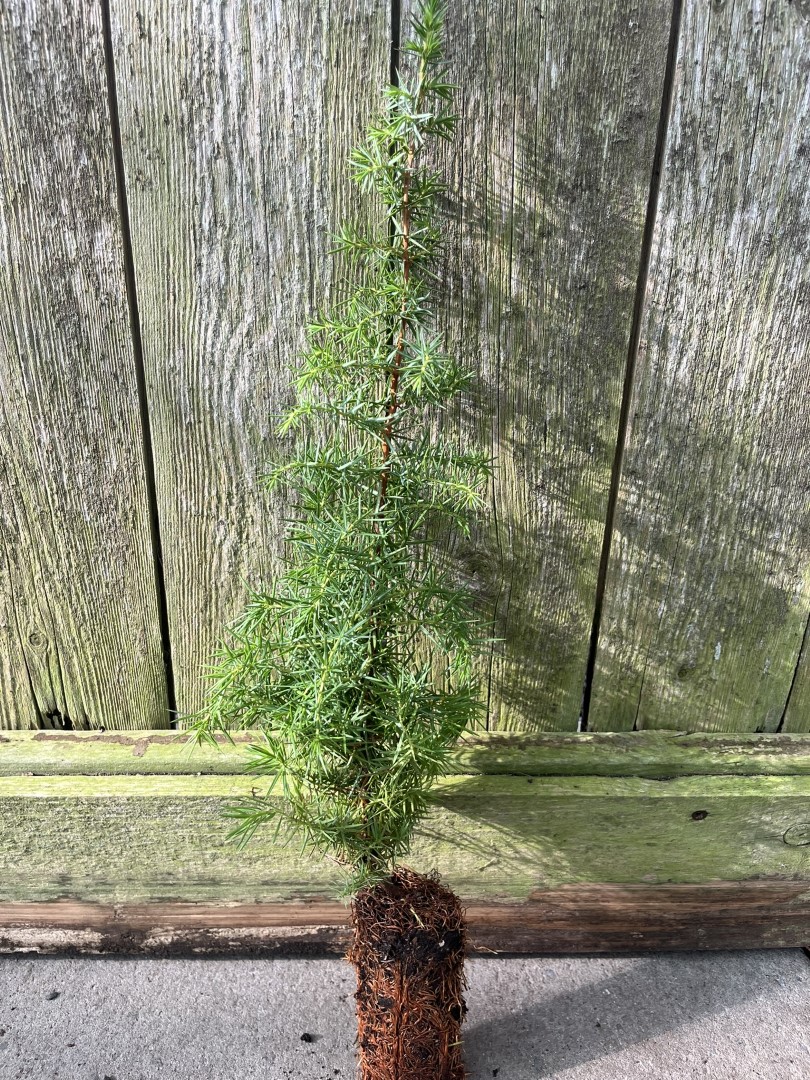
Common Juniper Bush – Juniperus communis is a hardy native evergreen with grey-green, silver-banded needles and aromatic blue-black berries. Supplied at 20/40cm in cells for fast establishment, it thrives in full sun on free-draining, chalky or sandy soils. Ideal for coastal and exposed sites, wildlife planting, rock gardens and informal native screens.
In stock - Usually dispatched within a few days.
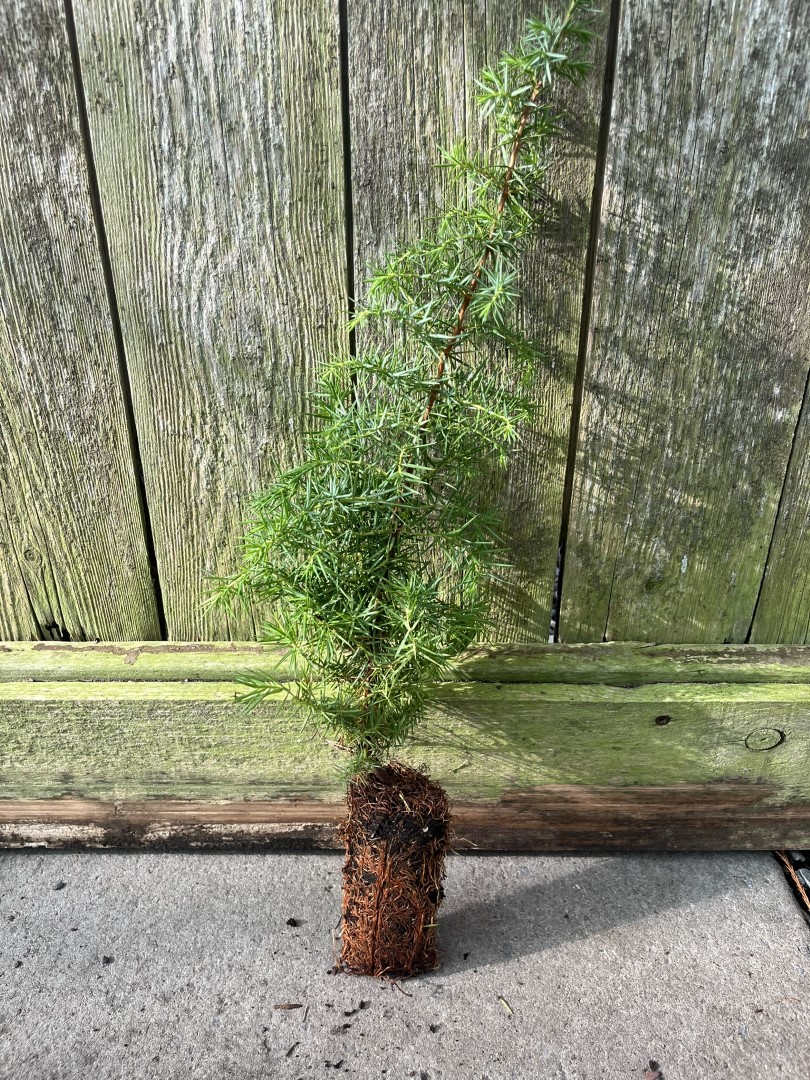
Common Juniper Bush – Juniperus communis is one of only three conifers native to Britain, and it remains one of the most adaptable evergreens available for hedging, shelter planting and wildlife schemes. These young plants are supplied at 20/40cm in cell form, meaning each one has an established, undisturbed root plug that transplants quickly and establishes with far less check than bare-root stock.
The foliage is needle-like rather than scaly, arranged in whorls of three, with a sharp point and a distinctive silvery-white band running along the upper surface of each needle. This gives mature plants a grey-green, slightly frosted appearance that holds its colour through winter. Growth habit is naturally variable: some plants form low, spreading mounds, while others develop into upright, conical or columnar shrubs. This variation is part of the species’ character and makes it useful for informal planting where uniformity is not the goal.
Female plants produce small green berry-like cones that ripen to a deep blue-black over two to three years. These are the juniper berries used to flavour gin and game dishes, and they are also a valuable late-season food source for thrushes, fieldfares and ring ouzels. The dense, prickly structure offers excellent nesting cover for small birds, and juniper scrub supports a long list of specialist invertebrates.
Common juniper is tolerant of exposure, salt-laden wind, drought and poor, thin soils, including chalk and limestone. It is an excellent choice for coastal gardens, upland sites, rock gardens, gravel schemes and mixed native screens. It will not tolerate waterlogging, so heavy clay sites need improving or raising before planting.
Care Guide
Plant between autumn and early spring, avoiding periods when the ground is frozen or saturated. Choose a position in full sun; juniper becomes thin, sparse and prone to dieback in shade. Free-draining soil is essential, and the plant is happy on alkaline, neutral or mildly acidic ground. On wet or compacted soils, incorporate grit and plant on a slight mound.
Space plants 60–90cm apart for a hedge or informal screen. Firm the soil well, water thoroughly after planting and apply a mulch of bark or gravel, keeping it clear of the stem. Water during the first two summers in dry spells, particularly on sandy or chalky ground; once established, plants rarely need irrigation even through a British summer drought.
Feeding is seldom necessary. A light application of general-purpose fertiliser in spring will help young plants on very poor soil, but overfeeding encourages soft, floppy growth. Pruning should be minimal — juniper does not reliably regenerate from old brown wood, so trim only the current season’s green growth in late spring or early summer if shaping is needed.
Watch for juniper scale and aphids in warm, dry conditions, and remove any branches showing dieback or Phytophthora symptoms promptly. Wear gloves when handling, as the needles are genuinely sharp.
Ultimate height
2.5–4 metres
Time to ultimate height
20–50 years
Ultimate spread
1.5–2.5 metres
Season of Interest
Spring, Summer, Autumn, Winter
Sunlight
Full Sun, Partial Shade
Pot Size
Cell
Foliage
Evergreen
Foliage Colour
Green
Hardiness
-20°C and below (H7)
When MatureWatering
Moderate
Preferred Soil Type
Any well drained soil
Preferred Soil pH
Neutral
British Native Trees Great for wildlife Trees UK Grown Trees
Our deep cell trays are a smart strategy for cultivating trees with strong and deep root systems. This leads to healthier and more resilient trees that are better prepared for transplantation and long-term growth in your garden.
Extended Planting Season
Cell grown trees offer a significantly broader planting window, allowing for planting almost year-round in certain conditions. This flexibility ensures easier scheduling and enhances tree establishment due to warmer soil and more favourable weather conditions, extending beyond the traditional planting season.
Robust Root System
The roots of cell grown trees are encased and safeguarded within compost, preventing the young fibrous roots from drying out or sustaining damage. This intact root system, with its uniform and manageable shape, facilitates straightforward planting.
Convenient Storage
These trees can be effortlessly stored outdoors before planting, eliminating the need for labour-intensive temporary planting (heeling in) or costly refrigerated storage.
Ease of Handling and Planting
The extended shelf life of cell grown trees means there’s no immediate urgency to plant. Their user-friendly root system increases the likelihood of successful planting. These characteristics make them ideal for planting by novices or volunteers.
High Survival Rate
The intact root system of cell grown trees significantly boosts their chances of successful establishment, virtually removing the need for expensive replanting (beating up).
Cost-Effectiveness
While the initial purchase price of cell grown trees may be slightly higher than bare-root stock for some species, the long-term savings achieved by reducing the need for replacing failed transplants than compensates for the initial minor cost difference.
No plastic waste
Trees are often supplied plastic pots that are difficult to recycle, especially the black pots. We rely on our customers to reuse these where possible, however these cell grown trees do not have plastic pots – saving any reuse & recycling concerns.
Delivery
Yarrow Gardens aim to have your order with you in fastest time possible and safest method of transport. Dependent on the parcel size and geographical destination in mind with will select the most suitable courier.
You are welcome to collect any times from our nursery in Euxton, Lancashire. Please contact us to arrange a suitable date and time.
With regret, we can no longer send items out to Northern Ireland. All live plants need a phytosanitary checks and DAERA must be notified. This process is simply too expensive at the moment.
Returns
In the rare instance that your item has been damaged during delivery or incorrectly shipped by us, please contact us and we will be happy to discuss the return and replacement of your item.
Once you have contacted us and we have confirmation that your parcel is on its way back to us we will be happy to issue a refund for the return postage.
| Delivery Class | Delivery Cost | |
|---|---|---|
| Royal Mail Letter - Royal Mail Tracked | £3.25 (Flat) | |
| Royal Mail Letter - Royal Mail Second Class | £1.32 (Flat) | |
| Royal Mail Large Letter - Royal Mail Tracked | £3.25 (Flat) | |
| Royal Mail Large Letter - Royal Mail Second Class | £2.10 (Flat) | |
| Standard Items - Standard Courier (APC) | £10.74 (Flat) | This item |
| Standard Items - Standard Courier (Evri) | £5.99 (Flat) | This item |
| Medium Items - Standard Courier (APC) | £11.94 (Flat) | |
| Large Items - Pallet Courier | £114.00 (Flat) | |
| Large Items - Standard Courier (APC) | £25.14 (Flat) | |
| Pallet Courier - Pallet Courier | £114.00 (Flat) |
We are a small family business based in Euxton, West Lancashire. We specialise in the supply of trees, shrubs both bare root & cell grown. Much of our stock is grown directly on site from seed or cuttings. Other stock is all UK sourced where possible.
We adhere to industry leading biosecurity measures, this ensures that our nursery remains clean and disease free.
We are DEFRA registered and our nursery is regularly inspected to confirm compliance with all current plant and plant health regulations.
Our Plant Passport Registration Number is GB140010
You can view our Plant Healthy report here.
We are actively working towards the Grown in Britain certification along with the Plant Healthy certification.
Should you have any concern or question in respect of our plant health matters, please get in touch.
Also available...

Common Juniper Bush 20/40cm (9cm)
Juniperus communis

Coast Redwood ‘Lightning’ 40/60cm (3L)
Sequoia sempervirens

Coast Redwood Tree 20/40cm (Cell)